Corporate Holiday Party Games: How to Organize an Interactive Tournament
Planning a corporate holiday party that keeps employees entertained, engaged, and connected can be challenging, especially when you’re trying to find activities that appeal to different personalities and skill levels. Traditional holiday celebrations often revolve around food, drinks, and conversation, but incorporating interactive holiday party games for work can give employees something new to experience together.
Creating opportunities for employees to connect outside their everyday responsibilities also has value beyond the celebration itself. According to Gallup’s research on workplace friendships, meaningful connections between coworkers are associated with stronger employee engagement and important business outcomes. A thoughtfully organized holiday tournament can encourage those connections through friendly competition, shared experiences, and a little team spirit.
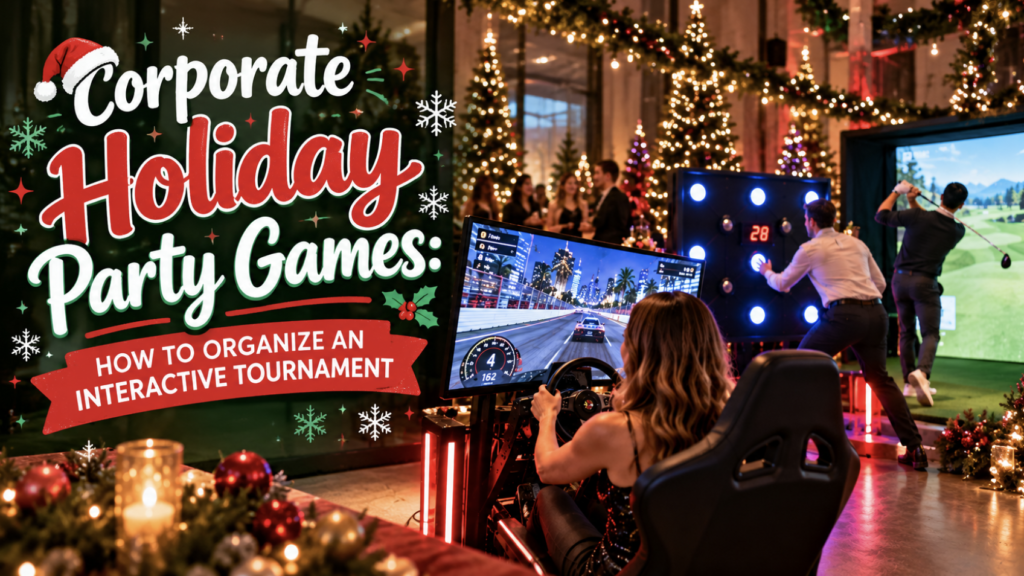
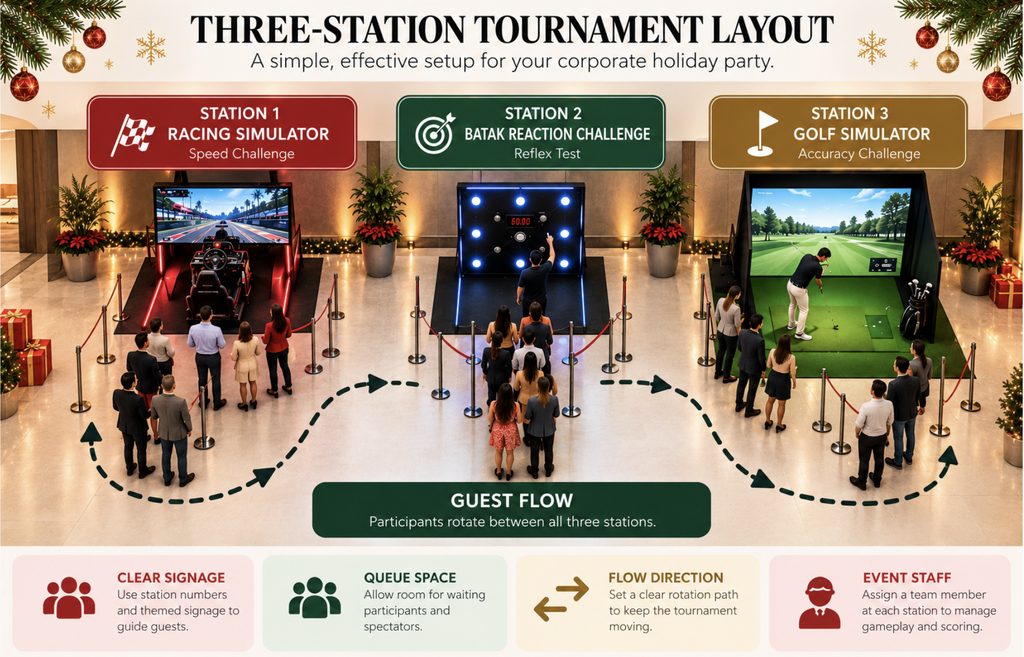
Instead of offering individual games without a clear structure, imagine transforming your corporate holiday party into an interactive tournament where employees rotate between a Racing Simulator, BATAK Reaction Challenge, and Golf Simulator. With a simple scoring system, organized station rotations, and prizes for top performers, you can create an experience that keeps guests involved throughout the event.
Table of Contents
Why Turn Your Corporate Holiday Party Into a Tournament?
Traditional office holiday party games can be entertaining, but without a clear structure, guests may participate once and move on. An interactive tournament creates a shared experience that encourages employees to stay involved, cheer each other on, and connect with colleagues across different departments.
Rather than relying on a single activity, a tournament introduces multiple challenges that test different skills. Some employees might excel at racing, while others perform better in reaction-based games or golf. This variety gives participants different opportunities to succeed without requiring previous experience.
For corporate event planners, a tournament format offers several practical advantages:
STRUCTURED PARTICIPATION: Organized rotations help distribute guests across activities and reduce overcrowding at individual stations.
TEAM BUILDING: Friendly competition encourages interaction between coworkers who might not regularly work together.
FLEXIBLE COMPETITION FORMATS: Individual scores, team totals, or department-based challenges can be adapted to the event’s goals.
A MEMORABLE FINALE: Leaderboards, prizes, and a winner announcement give the celebration a natural highlight.
The key is balancing competition with accessibility. A successful corporate holiday tournament should feel welcoming to beginners, offer straightforward instructions, and allow employees to participate without feeling pressured.
Next, we’ll explore how to bring this concept to life using three interactive game stations, including a practical tournament setup that event planners can adapt to their guest count and schedule.
How to Set Up a Three-Station Corporate Holiday Tournament
One way to make corporate holiday party games more engaging is to organize them into a three-station tournament. Instead of having guests compete in a single activity, participants move between different challenges, earning points at each station toward an overall score.
For example, a corporate holiday party could feature a Racing Simulator, BATAK Reaction Challenge, and Golf Simulator. Each activity tests a different skill, creating a balanced competition that rewards speed, reaction time, and precision.
STATION 1: Racing Simulator – The Speed Challenge
Participants compete to record their fastest lap on a selected racing circuit. Each driver receives the same track, vehicle settings, and number of attempts to ensure a consistent competition. The fastest valid lap earns the highest ranking.
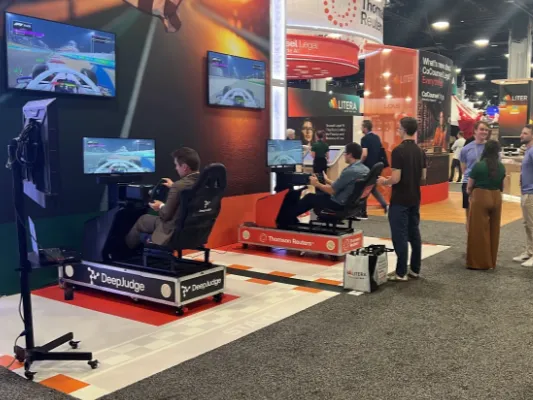
Session Run Time: 2-3 minutes
Space Required: 8 ft x 5 ft recommended play area
Capacity: 1 player at a time; approx. 15 participants per hour
STATION 2: BATAK Reaction Challenge – The Reflex Test
Employees compete to hit as many illuminated targets as possible within a fixed time limit. Scores are based on successful hits, making this a straightforward challenge that’s easy for spectators to follow. Participants use the same game mode and time limit.
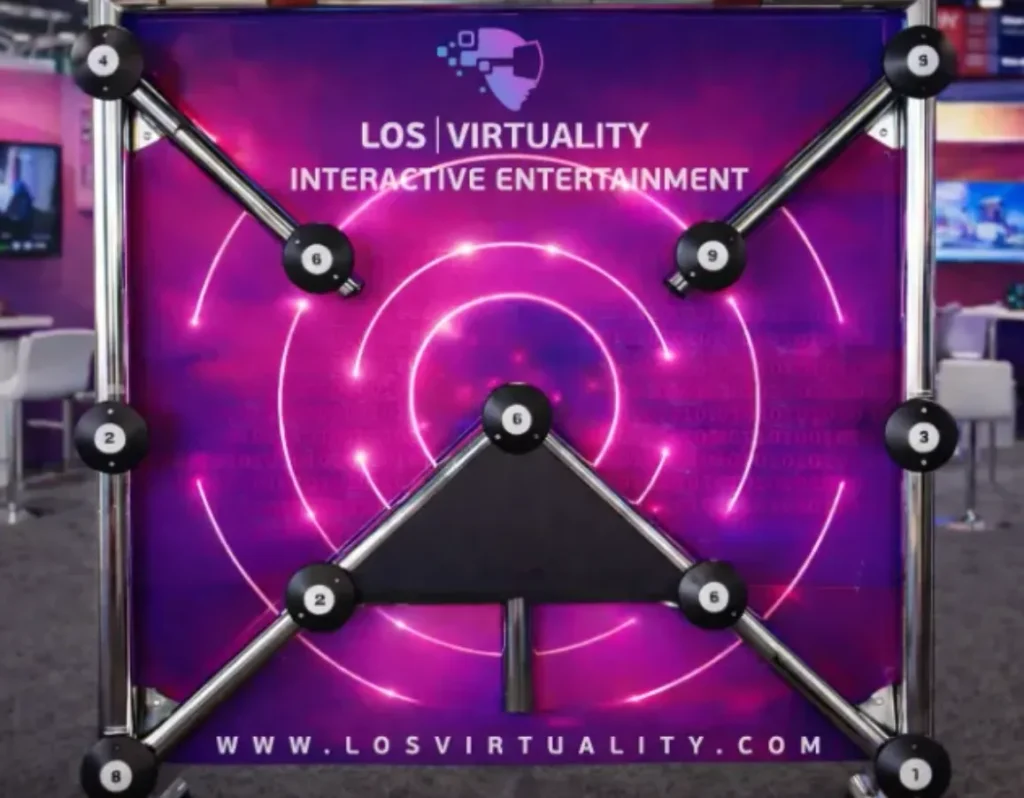
Session Run Time: 1-2 minutes
Space Required: 6 ft x 6 ft recommended play area
Capacity: 1 player at a time; approx. 30 participants per hour
STATION 3: Golf Simulator – The Accuracy Challenge
Participants aim for a designated target in a virtual golf challenge. Each player receives the same number of shots, with points awarded based on accuracy. A closest-to-the-pin format can work well, provided the simulator’s available game modes support it.
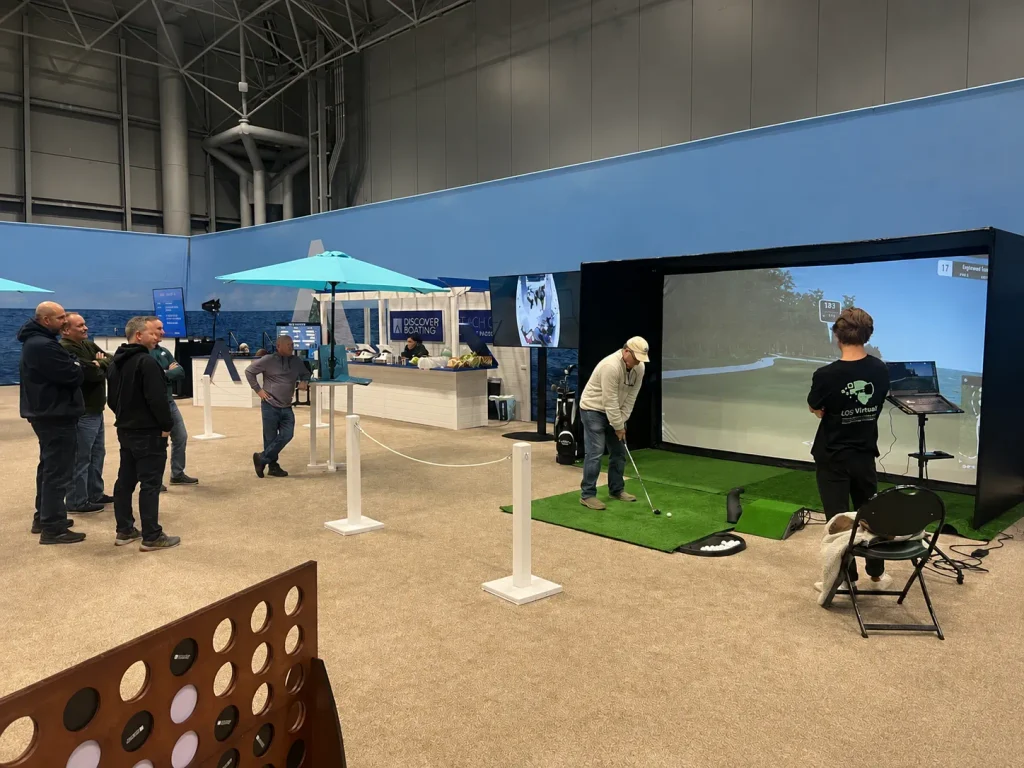
Session Run Time: 3-4 minutes
Space Required: 14 ft x 10 ft recommended play area
Capacity: 1 player at a time; approx. 20 participants per hour
How to Organize Station Rotations for Corporate Holiday Party Games
One of the biggest challenges when organizing holiday party games for work is keeping the competition moving without creating long lines or leaving participants waiting between activities. A structured rotation schedule helps distribute guests across stations while giving everyone a fair opportunity to compete.
For a three-station tournament featuring a Racing Simulator, BATAK Reaction Challenge, and Golf Simulator, the key is planning around each activity’s participation capacity. Since some challenges take longer than others, organizers should establish realistic time slots rather than expecting every station to accommodate the same number of guests.
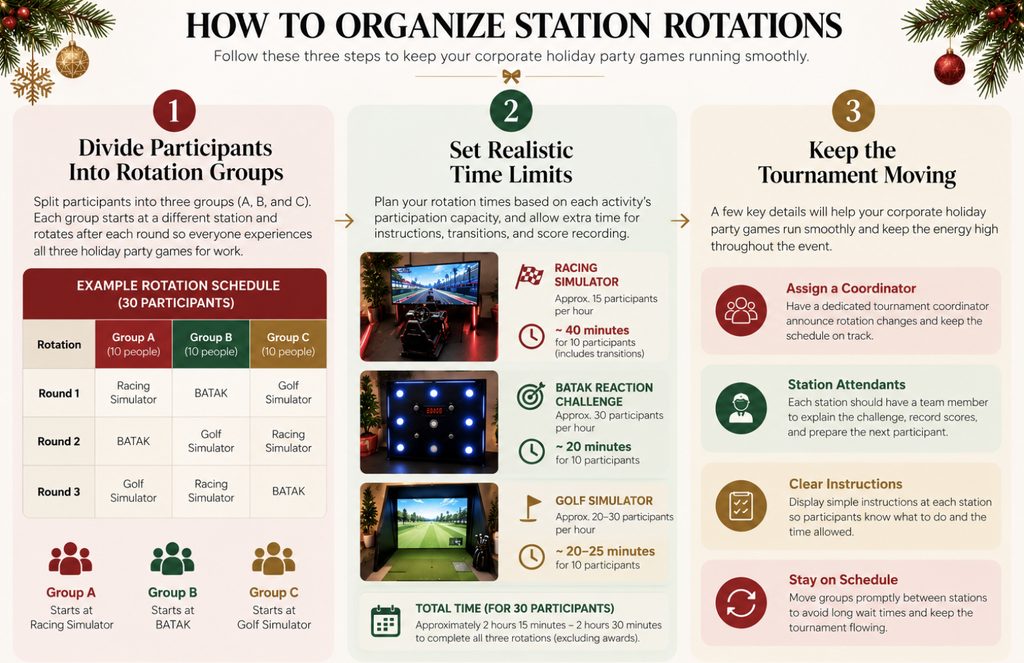
A well-organized rotation schedule helps turn corporate holiday party games into a seamless experience rather than a series of disconnected activities. By balancing station capacities, allowing enough time for each challenge, and keeping participants informed, event planners can create a tournament that feels competitive without becoming overwhelming. Once the rotation schedule is established, the next step is developing a fair scoring system that keeps employees motivated and makes it easy to determine the winners.
How to Create a Fair Scoring System and Determine Tournament Winners
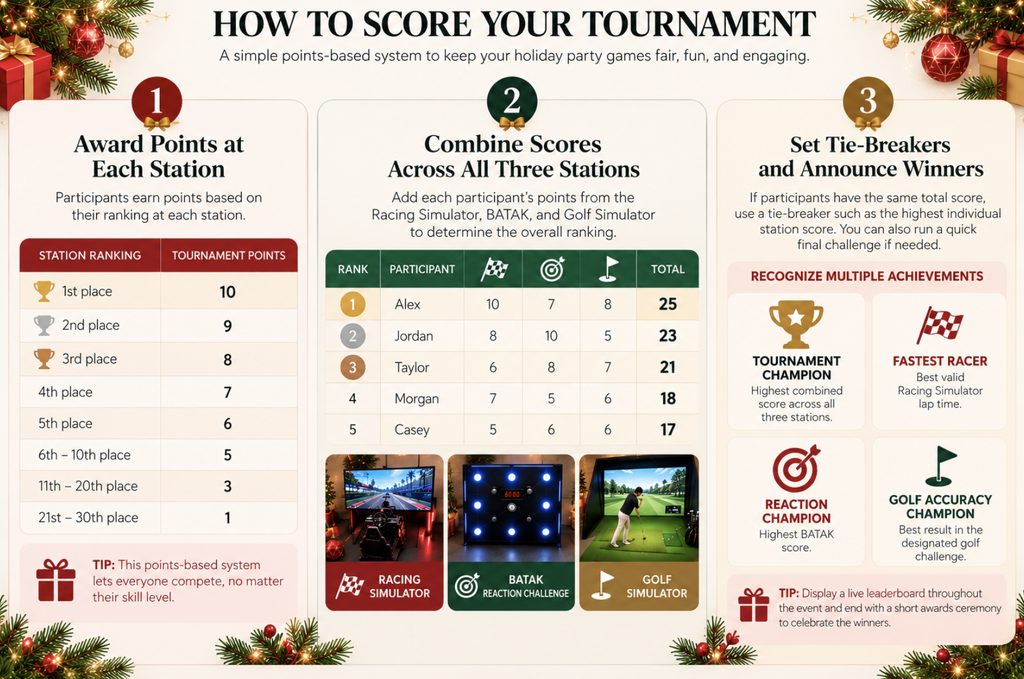
A successful corporate holiday party tournament needs a scoring system that’s easy to understand, fair for beginners, and exciting enough to encourage friendly competition. Since the Racing Simulator, BATAK Reaction Challenge, and Golf Simulator measure different skills, comparing raw scores wouldn’t provide an accurate overall ranking.
The infographic below illustrates how a simple points-based system can turn corporate holiday party games into a fair and organized competition. By awarding points based on individual station rankings and combining results across all three challenges, event planners can recognize consistent performance while keeping the tournament accessible to different skill levels. The example also highlights how leaderboards, tie-breakers, and multiple award categories can make the competition more engaging for everyone involved.
Corporate Holiday Party Tournament Formats for Different Guest Counts
Not every company celebration has the same number of attendees, and the best tournament format depends on how many employees want to participate, how much time is available, and the number of game stations provided. Whether you’re planning office holiday party games for a small team or organizing a large corporate celebration, adapting the competition to your guest count helps keep the experience enjoyable and manageable.
For a tournament featuring one Racing Simulator, one BATAK Reaction Challenge, and one Golf Simulator, the Racing Simulator will typically determine how many employees can complete all three challenges. With an estimated capacity of approximately 15 participants per hour, planners should avoid scheduling more competitors than the equipment can realistically accommodate.
Small Corporate Holiday Parties: 15–25 Guests
For smaller teams, an individual tournament offers a straightforward way to encourage participation. Employees can compete across all three stations, with their combined scores determining the overall winner.
With 15 registered competitors, the Racing Simulator would require approximately one hour at its estimated participation rate. Allow additional time for instructions, station transitions, and final score verification. A smaller tournament also creates opportunities for coworkers to watch and cheer on participants between their turns.
Mid-Sized Corporate Events: 30–60 Guests
For mid-sized celebrations, consider limiting the tournament to 30 registered competitors while keeping other entertainment available for guests who prefer casual participation.
Divide competitors into three groups of 10 and rotate them between the Racing Simulator, BATAK, and Golf Simulator. With approximately 45–50 minutes per rotation, the competition could take around 2 hours and 15 minutes to 2 hours and 30 minutes. This format works especially well when tournament participation is optional rather than mandatory.
These estimates assume efficient station operations and short competition formats. Planners should confirm timing with their entertainment provider and allow additional flexibility for instructions, transitions, and unexpected delays.
Large Corporate Holiday Parties: 75–150+ Guests
For larger celebrations, requiring every attendee to complete all three stations may create long waits. Instead, event planners can offer open-play activities alongside a smaller tournament for registered participants.
Another option is to add equipment units to increase participation capacity. For example, two Racing Simulators could potentially accommodate more competitors than one, provided the venue has sufficient space, power, and staffing. For very large events, consider department-based competitions, scheduled qualifying sessions, or a limited number of tournament spots.
For additional guidance on guest participation, venue considerations, and entertainment planning, explore our Corporate Holiday Party Entertainment Guide.
How to Make Holiday Party Games for Work More Inclusive and Engaging
The best holiday party games for work aren’t necessarily the most competitive. They’re the ones that encourage employees to participate, connect with coworkers, and enjoy the celebration regardless of their experience or skill level. While an interactive tournament introduces friendly competition, thoughtful planning ensures the experience remains welcoming to everyone.
For HR teams and corporate event planners, creating an inclusive atmosphere is especially important when organizing office holiday party games for employees with different interests, abilities, and comfort levels.
Choose Corporate Holiday Party Games That Appeal to Different Skills
Offering a variety of challenges helps prevent the tournament from favoring one type of participant. A Racing Simulator tests driving precision, BATAK focuses on reaction speed, and a Golf Simulator introduces an accuracy-based challenge.
By combining different activities, employees have multiple opportunities to perform well, even if they’re unfamiliar with one of the games. Provide a brief explanation or practice opportunity before each challenge, and use consistent settings so experienced players don’t receive an unfair advantage.
Encourage Participation Without Making Competition Mandatory
Not everyone enjoys competing, and that’s perfectly fine. Consider allowing employees to participate casually, cheer on teammates, or watch the leaderboard without registering for the tournament.
For larger corporate holiday parties, a designated open-play period can give guests an opportunity to try the experiences outside the competition. This approach helps accommodate different personalities while keeping the tournament organized.
Make Team Building Part of the Experience
Corporate holiday party games can also encourage connections between departments. Rather than focusing exclusively on individual winners, event planners can introduce optional team-based challenges where employees contribute points toward a shared department or group score.
For example, teams could earn points based on their members’ combined tournament results, with an additional award for the highest-scoring department. This creates opportunities for coworkers to support one another and adds another layer of engagement to the celebration.
Consider Accessibility and Guest Comfort
Before selecting tournament activities, discuss accessibility requirements with your entertainment provider and venue. Consider equipment access, seating, mobility needs, noise levels, and whether alternative participation options can be accommodated.
Clear instructions, accessible pathways, and comfortable spectator areas can make a meaningful difference in the overall guest experience. Avoid assuming every employee will be able or willing to participate in every challenge.
Frequently Asked Questions About Corporate Holiday Party Games
How do you organize office holiday party games for large groups?
For larger corporate events, divide registered competitors into smaller rotation groups and assign scheduled time slots at each station. Consider limiting tournament registration, providing casual activities for other guests, or adding equipment units to increase participation capacity. Planning around the slowest station helps prevent long lines and scheduling conflicts.
Can employees participate if they’ve never used a racing or golf simulator?
Yes. Corporate holiday party games should be welcoming to beginners as well as experienced players. Provide clear instructions, consistent game settings, and brief practice opportunities when the schedule allows. Employees who prefer not to compete can still enjoy watching, cheering on coworkers, or participating during designated open-play periods.
What equipment and space are needed for an interactive holiday party tournament?
A three-station tournament requires sufficient room for the selected equipment, participant queues, spectators, and safe movement between activities. Planners should confirm each station’s footprint, power requirements, staffing, and installation schedule with their entertainment provider. Additional space may be needed for a leaderboard, registration area, or awards presentation.
What are the best holiday party games for a workplace environment?
The best holiday party games encourage employee participation, teamwork, and friendly competition. Interactive experiences such as Racing Simulators, BATAK Reaction Challenges, and Golf Simulators work well for corporate holiday tournaments because they test different skills and can be organized into structured competitions. The ideal activities depend on your guest count, venue, and event goals.
How long does a corporate holiday party tournament take?
Tournament duration depends on the number of participants, available equipment, and length of each challenge. For example, a three-station tournament with 30 registered competitors and one unit per station may require approximately 2.5 hours, including rotations and transitions. Event planners should also allow additional time for instructions, score verification, and an awards ceremony.
Final Thoughts
The best corporate holiday party games do more than entertain employees. They create opportunities for connection, friendly competition, and shared experiences that bring teams together beyond the workplace.
By combining interactive challenges with organized rotations, fair scoring, and realistic scheduling, event planners can transform a traditional office celebration into a memorable holiday tournament. Whether you’re planning for a small team or a large corporate gathering, the key is creating an experience that balances competition, accessibility, and fun.
We help companies bring these experiences to life with interactive entertainment, including Racing Simulators, BATAK Reaction Challenges, and Golf Simulators. Explore our corporate event rentals to discover how we can help you create an engaging holiday celebration tailored to your team. If you’re ready to turn your next corporate holiday party into an interactive tournament, contact us to start planning.