500 Guests, 3 Hours: How Much Interactive Entertainment Does Your Event Actually Need?
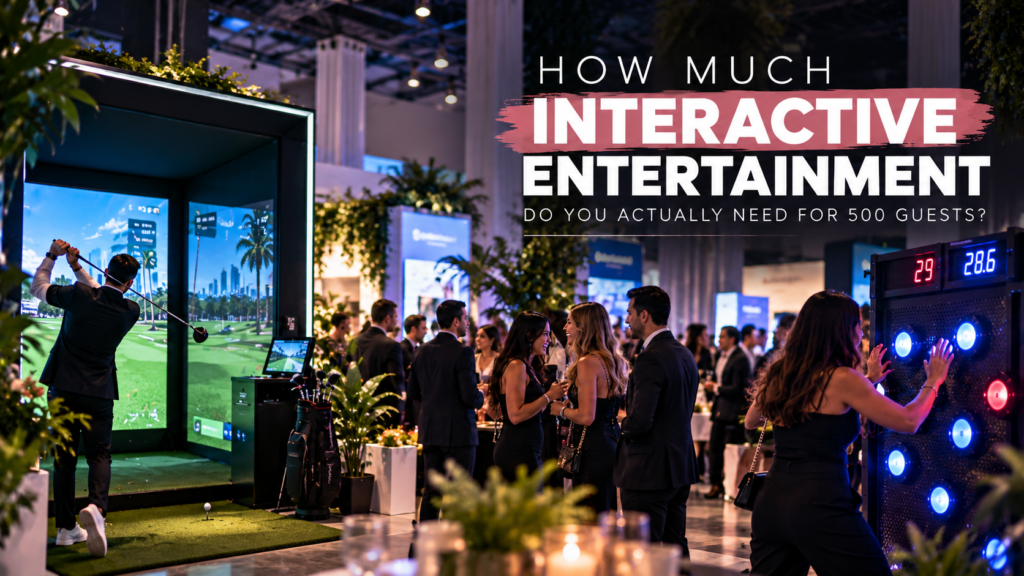
Planning an event for 500 guests with only three hours to keep everyone engaged? One of the biggest questions event planners face is how much interactive entertainment they actually need to create a memorable experience without overwhelming the space or leaving guests waiting in long lines.
According to Freeman’s 2024 Attendee Trends Report, 64% of surveyed attendees identified immersive experiences as one of the top three factors that positively influence their overall event experience. Delivering those experiences successfully takes more than simply adding activities to your event.
Not every guest will participate in the same way. Some may head straight for a competitive racing simulator or reaction challenge, while others might prefer a personalized AI photo experience or watching their coworkers compete before giving something a try. Meanwhile, you’re balancing food and drinks, networking opportunities, event programming, available space, and a limited schedule. Even with several activities available, one popular attraction can quickly develop a line while another sees fewer participants. That’s why choosing entertainment for large events involves more than simply offering enough options.
The right setup depends on expected participation, hourly capacity, guest flow, and the type of event you’re hosting. A 500-person corporate celebration where entertainment is a main attraction may require a different approach than a trade show with 500 attendees moving between booths, meetings, and presentations. Understanding these differences can help planners avoid overcrowded activations, unnecessary rentals, and missed opportunities for guest engagement.
In this guide, we’ll break down how to estimate your interactive entertainment needs using a 500-guest, three-hour event as an example. We’ll explore how different experiences can work together to balance participation, minimize wait times, and help you determine the right entertainment mix for your event.
Table of Contents
Start With Your Guest Count and Event Length
Let’s say you’re planning a corporate event with 500 guests and a three-hour window for entertainment. At first glance, you might assume that a larger guest count automatically means you need more activities. Attendance alone doesn’t tell you how many interactive experiences your event actually needs.
Consider two events with the same 500-person guest list. One is a company celebration where interactive entertainment is a major part of the evening. The other is a trade show where attendees are moving between exhibitor booths, networking, and attending presentations. Even though both events have the same number of guests and the same three-hour timeframe, the demand for entertainment could be very different.
Event length also matters. A three-hour event doesn’t necessarily mean guests will be participating in activities continuously for all three hours. People may arrive at different times, take breaks for food and drinks, or spend portions of the event socializing. In some cases, participation may spike during certain periods, creating longer lines even when an activation has enough total capacity to accommodate the expected number of guests.
Before deciding how many experiences to rent, planners should consider how entertainment fits into the overall event schedule. Is it the main attraction, or one of several activities available? Will guests have the full three hours to participate, or will speeches, presentations, and other programming reduce that window?
These details provide the foundation for estimating participation and determining how much entertainment capacity your event actually needs.
Estimate How Many Guests Will Actually Participate
Just because 500 people are attending your event doesn’t mean all 500 will participate in the available entertainment. Some guests may want to try every activity, while others might participate once or twice, spend most of their time networking, or simply enjoy watching the action.
This is where estimating your participation rate becomes an important part of event entertainment planning. Rather than assuming every attendee will use an activation, planners can estimate the percentage of guests likely to participate based on the event format, audience, and role entertainment plays in the overall experience.
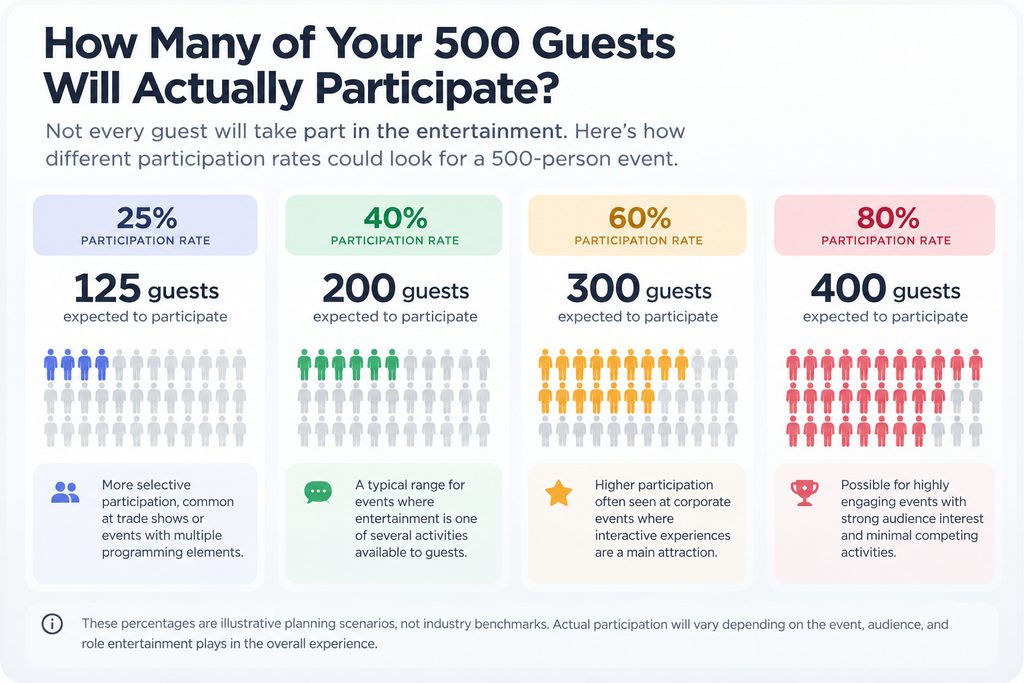
A corporate celebration with interactive activities as a main attraction may see more guests interested in participating, especially when experiences encourage friendly competition between coworkers. At a trade show, participation may be more selective, with attendees stopping by an activation between meetings, presentations, and exhibitor visits.
It’s also important to distinguish between unique participants and total activity sessions. If 200 guests participate in entertainment but each tries two different experiences, that’s potentially 400 individual sessions to accommodate. This can make a significant difference when calculating how much capacity your entertainment lineup needs.
The goal isn’t to predict participation perfectly. It’s to establish a reasonable starting estimate that helps you plan for demand without overbooking equipment or leaving guests facing unnecessarily long wait times.
Compare Interactive Experiences by Capacity, Wait Times, and Guest Flow
1. Catch The Falling Stick
For events with hundreds of attendees, quick and engaging activities can help keep participation moving without requiring guests to commit too much time to a single experience. Catch the Stick is a reaction-based challenge where participants test their reflexes by catching falling sticks before they hit the ground. The simple concept makes it easy for guests to jump in, compete, and encourage others to give it a try.
Because the challenge is quick and visually engaging, it can also attract spectators who enjoy watching coworkers or fellow attendees test their reaction times. However, that attention can create lines during busy periods, especially when groups arrive together. Allowing space for spectators and maintaining an organized queue can help keep the experience accessible without interrupting nearby activities.
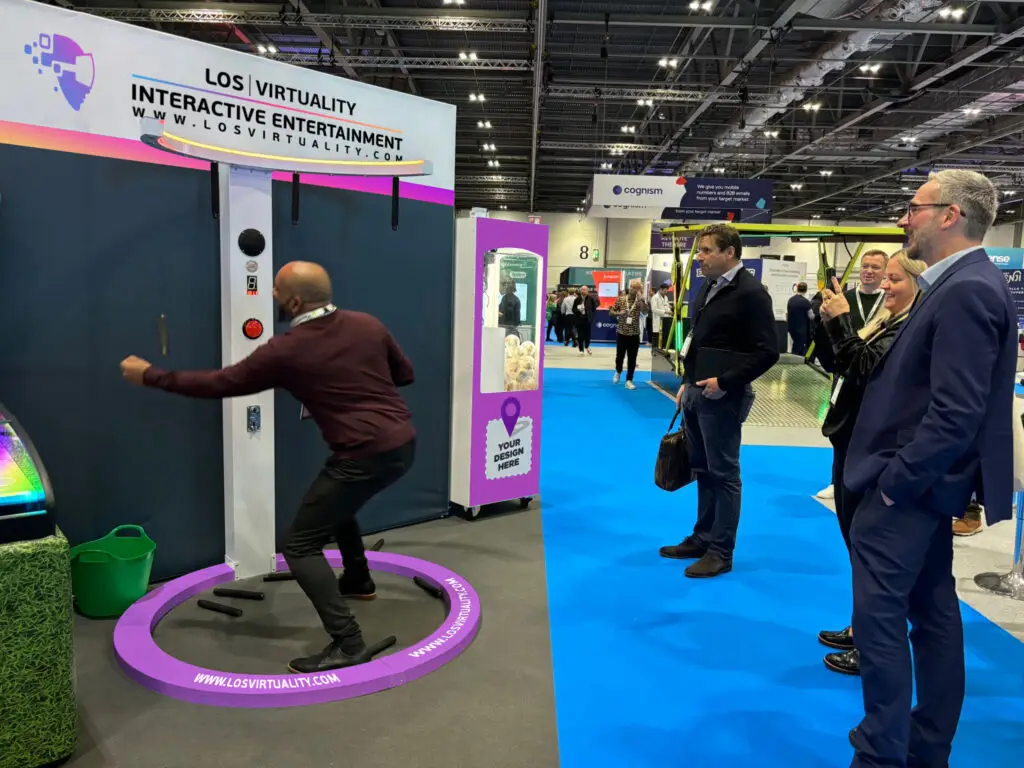
Session Run Time: 1-2 minutes
Space Required: 5 ft x 5 ft recommended play area
Capacity: 1 player at a time; approx. 30 participants per hour
2. BATAK Reaction Challenge
For planners looking to add a competitive element to their event, the BATAK Reaction Challenge offers a fast-paced experience that tests participants’ speed, coordination, and reflexes. Players race against the clock to hit illuminated targets as quickly as possible, making it an easy activity for guests to understand and enjoy without needing prior experience.
BATAK also creates opportunities for friendly competition, with guests comparing scores and challenging coworkers to beat their results. While this can encourage repeat participation, it may also increase demand during peak periods. Planners should account for spectators gathering around the activity and allow enough room for participants to enter and exit comfortably without disrupting nearby foot traffic.
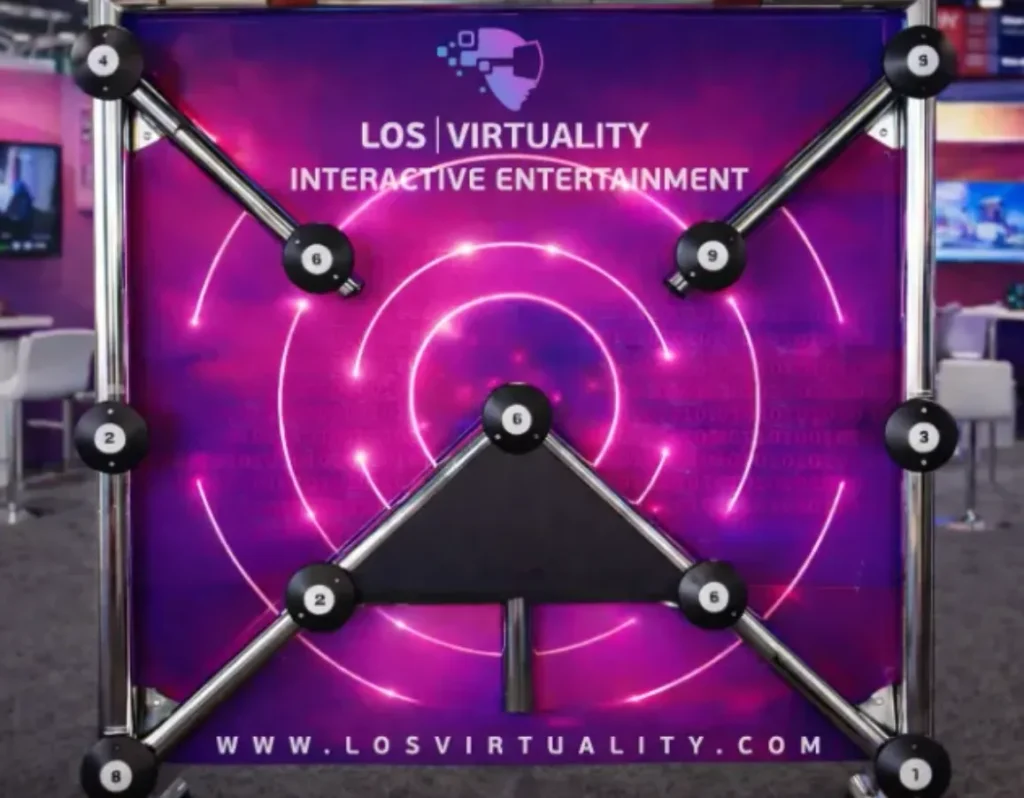
Session Run Time: 1-2 minutes
Space Required: 6 ft x 6 ft recommended play area
Capacity: 1 player at a time; approx. 30 participants per hour
3. Racing Simulator
Unlike quick reaction challenges, racing simulators offer a more immersive experience where guests can take the driver’s seat and compete on a virtual racetrack. With realistic steering controls, pedals, and racing visuals, participants can enjoy the excitement of racing without needing any previous driving or simulator experience. This makes racing simulators a popular option for corporate event entertainment, especially when planners want an activity that encourages friendly competition and draws attention from nearby guests.
Racing simulators can also attract spectators, particularly when coworkers compete for the fastest lap or challenge each other’s scores. While this adds excitement to the event, it can create longer queues during peak participation periods. For larger events, planners may want to consider multiple racing stations, shorter race formats, or a combination of other interactive experiences to help distribute demand.
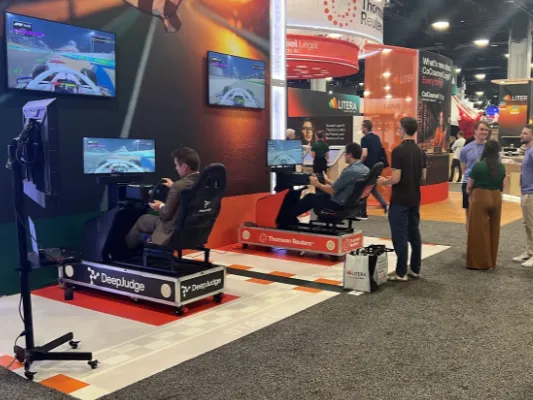
Session Run Time: 2-3 minutes
Space Required: 8 ft x 5 ft recommended play area
Capacity: 1 player at a time; approx. 15 participants per hour
4. AI Photo Booth
Not every interactive experience needs to revolve around competition. An AI Photo Booth gives guests an opportunity to create personalized, AI-generated images using custom themes, backgrounds, and branded visuals. Whether it’s a corporate celebration or a trade show activation, guests can walk away with a unique digital keepsake while brands gain an opportunity to extend their visibility beyond the event.
Hourly capacity depends on factors such as image processing time, the number of guests per session, and how quickly participants move through the experience. During a three-hour event, even small differences in session length can affect the total number of guests accommodated. Because personalized images often attract attention, a designated waiting area and clear instructions can help prevent lines from interfering with surrounding activities.
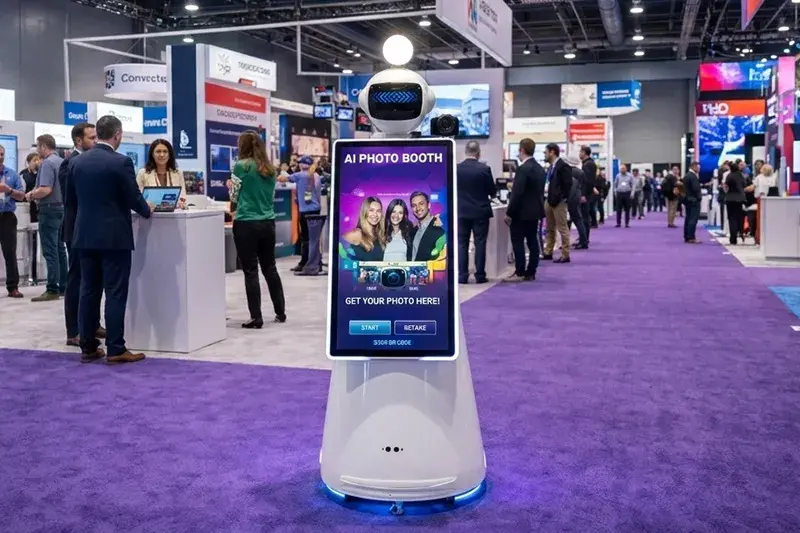
Session Run Time: 2-3 minutes
Space Required: 4 ft x 4 ft recommended play area
Capacity: 3 players at a time; approx. 90 participants per hour
5. Soccer Simulator
For events where planners want to introduce a sports-themed activity without requiring a full playing field, a Soccer Simulator offers guests the opportunity to test their shooting accuracy in an interactive setting. Participants take turns kicking soccer balls toward a digital target, making it an approachable experience for both casual players and soccer enthusiasts. The action can also draw nearby spectators, creating opportunities for friendly competition and group engagement.
For larger corporate events, the Soccer Simulator can encourage friendly competition between coworkers, while at trade shows, its visual appeal can help attract attention from attendees walking past an exhibitor’s space. However, planners should consider both the playing area and the space needed for spectators and waiting participants. Keeping the queue separate from nearby walkways can help maintain a comfortable flow throughout the event.
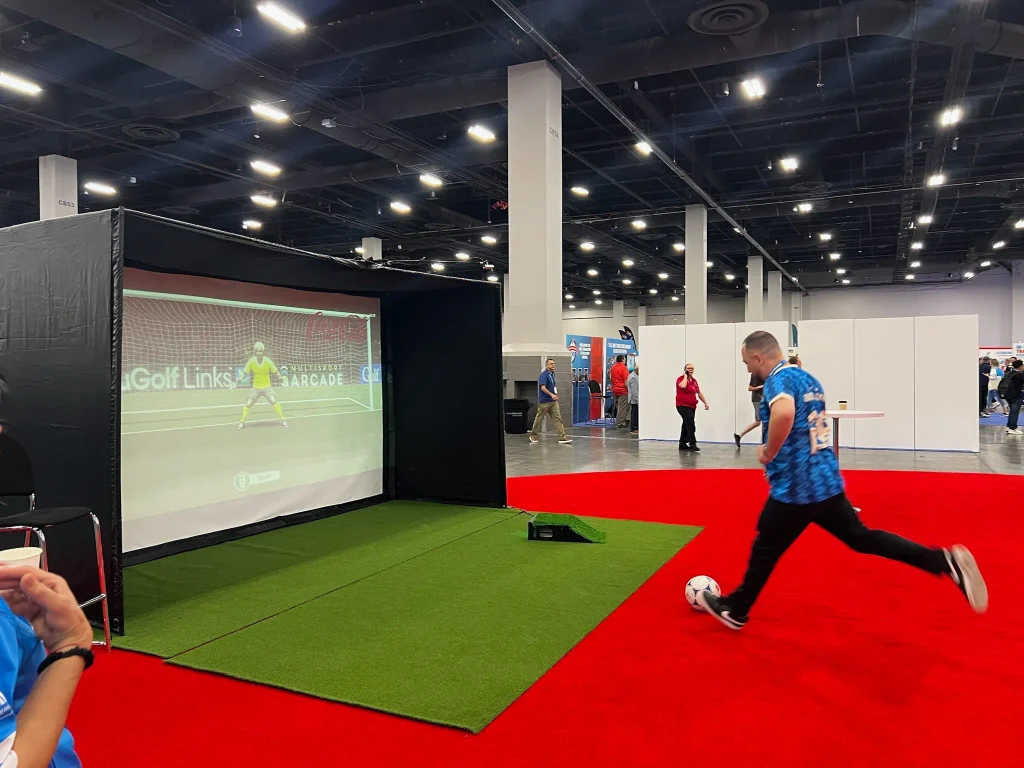
Session Run Time: 3-4 minutes
Space Required: 14 ft x 10 ft recommended play area
Capacity: 1 player at a time; approx. 20 participants per hour
6. Golf Simulator
Golf simulators offer a familiar activity that can be adapted to different event formats, from casual corporate gatherings to competitive trade show activations. Guests can practice their swing, aim for virtual targets, or compete in golf challenges without needing to visit an actual course. This flexibility makes a Golf Simulator an appealing option for interactive event entertainment, especially when planners want an experience that encourages both participation and conversation.
Golf simulators can also work well in networking environments, where guests may enjoy watching coworkers take a few swings while continuing conversations nearby. However, planners should account for differences in player experience. First-time golfers may need additional guidance, which can increase the time between participants. Providing clear instructions, setting consistent gameplay limits, and allowing enough space for safe swings and spectators can help maintain a steady flow.
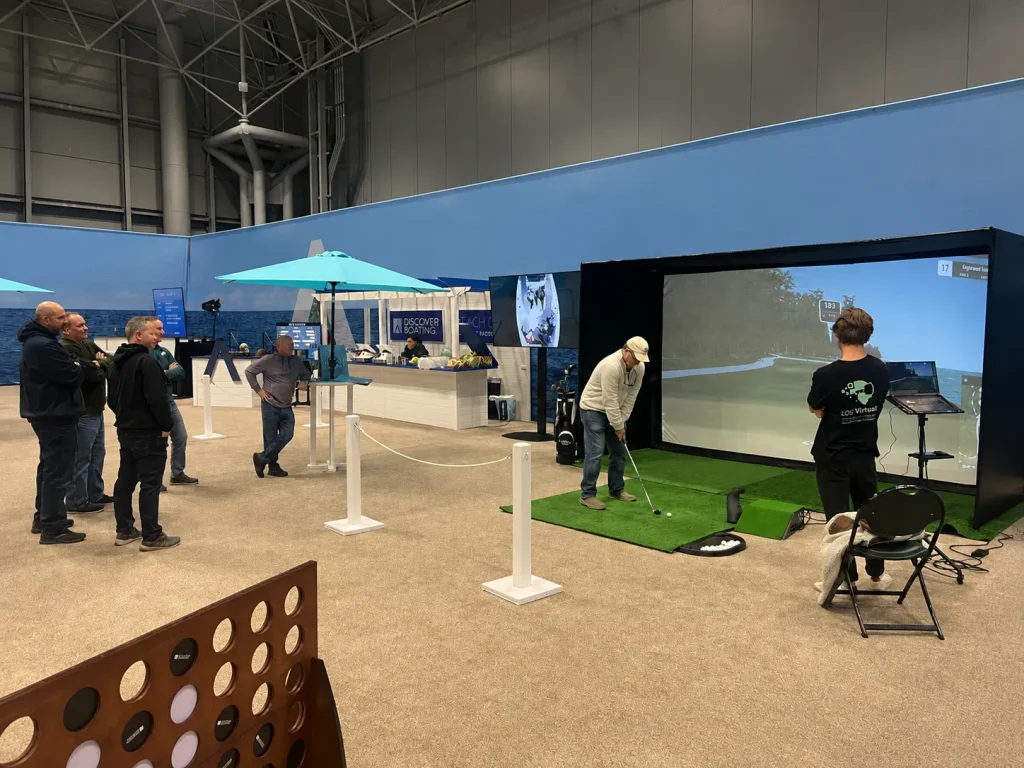
Session Run Time: 3-4 minutes
Space Required: 14 ft x 10 ft recommended play area
Capacity: 1 player at a time; approx. 20 participants per hour
Why the Mix of Interactive Experiences Matters
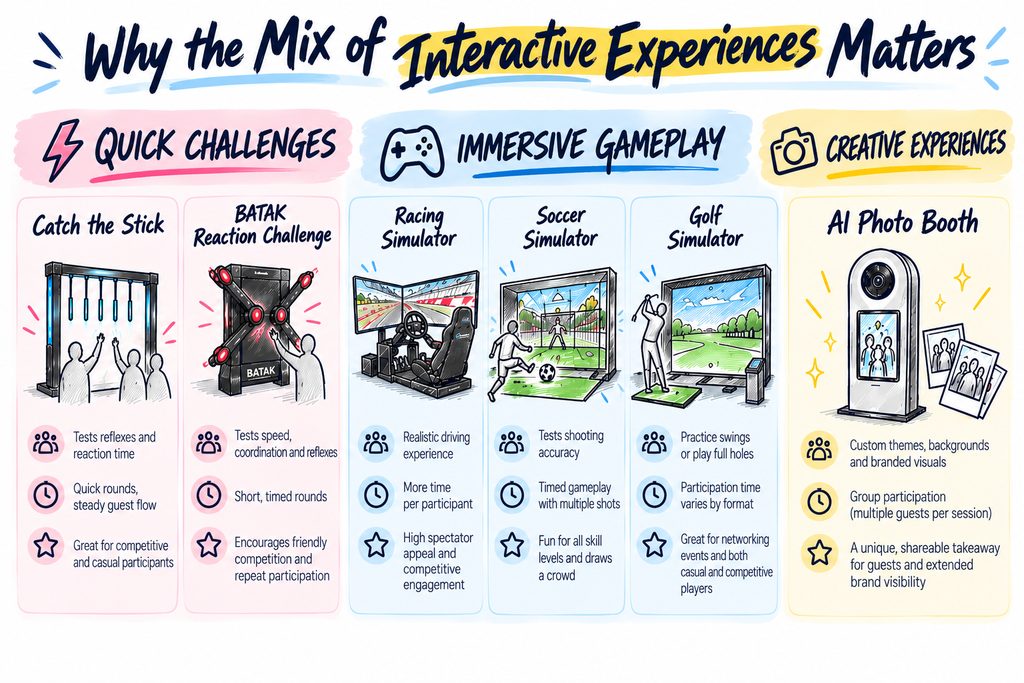
When planning entertainment for large events, offering more activities doesn’t automatically guarantee a better guest experience. The key is choosing a combination that accommodates different interests, participation styles, and hourly capacities. For example, a lineup consisting entirely of longer racing or golf challenges may create exciting moments but limit how many guests can participate. Meanwhile, relying exclusively on quick reaction games may keep lines moving but offer less variety for attendees looking for a more immersive experience.
A balanced interactive entertainment lineup can help distribute guests across different activities while reducing pressure on any single attraction. Quick challenges like Catch the Stick and BATAK encourage steady participation, while Racing Simulator, Soccer Simulator, and Golf Simulator introduce different gameplay styles. An AI Photo Booth offers a creative alternative for guests who prefer something less competitive. By considering both participation time and guest preferences, planners can create a more flexible entertainment setup that keeps people engaged throughout the event.
Corporate Event vs. Trade Show: How Much Entertainment Do You Actually Need?
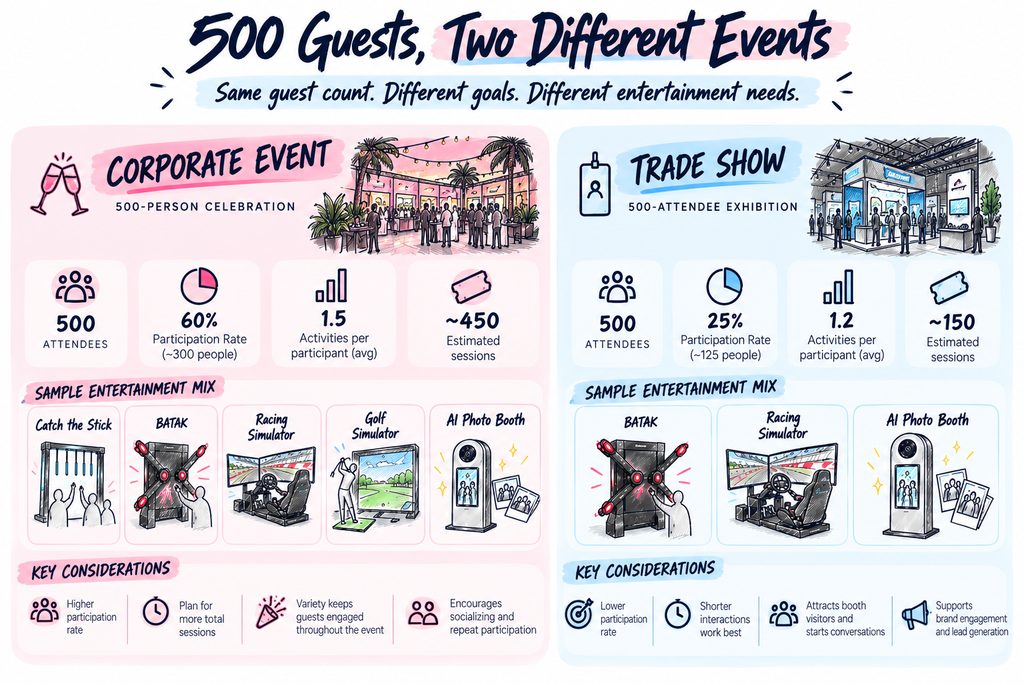
Two events can have the same 500-person guest count and three-hour schedule but require completely different entertainment setups. The difference comes down to why attendees are there, how they spend their time, and what organizers want the interactive experiences to accomplish.
At a corporate celebration, entertainment may be one of the main attractions, with guests encouraged to socialize, compete, and try multiple activities throughout the evening. At a trade show, attendees are typically balancing booth visits, meetings, presentations, and networking. Interactive entertainment may serve a more targeted purpose, such as attracting visitors to a booth, starting conversations, or creating memorable brand interactions.
Let’s compare two hypothetical 500-attendee events to see how participation estimates and entertainment needs might differ.
What Do These Scenarios Tell Us?
The corporate event generates an estimated 450 sessions, while the trade show generates approximately 150. That’s a significant difference despite both events having 500 attendees and the same three-hour entertainment window.
These figures are illustrative planning assumptions, not industry benchmarks. Actual demand will depend on audience interests, event programming, activity placement, and how many experiences guests choose to try.
The important takeaway is that guest count alone doesn’t determine how much interactive entertainment you need. Estimating participation, considering repeat activity, and comparing demand against realistic hourly capacity gives planners a much stronger starting point for building an effective entertainment lineup.
Frequently Asked Questions About Interactive Event Entertainment
How do I prevent long lines at interactive event activities?
Start by choosing a mix of experiences with different participation times and hourly capacities. Quick challenges like Catch the Stick and BATAK can help accommodate steady guest turnover, while longer activities like racing or golf simulators may benefit from structured gameplay limits. Providing designated waiting areas, spacing out popular attractions, and accounting for peak participation periods can also help reduce congestion.
How many interactive entertainment experiences do I need for 500 guests?
There isn’t a fixed number of experiences that works for every 500-person event. The right amount depends on expected participation, event length, hourly capacity, and how many activities each guest is likely to try. For example, if 300 guests are expected to participate in an average of 1.5 activities each, planners should prepare for approximately 450 total sessions. Comparing that demand against the combined capacity of your selected experiences can help determine how many stations you may need.
What types of interactive entertainment work best for large corporate events?
The most effective corporate event entertainment typically offers a variety of participation styles. Competitive challenges, immersive simulators, and creative experiences can appeal to different guest interests. For larger celebrations, combining activities with shorter rounds and longer gameplay can help distribute participation while giving guests multiple ways to engage.
How is trade show entertainment different from corporate event entertainment?
At corporate celebrations, entertainment may be a central part of the event, encouraging guests to socialize and participate in multiple activities. Trade show entertainment often serves a more targeted purpose, such as attracting booth visitors, increasing brand engagement, and starting conversations. Because attendees are also visiting exhibitors and attending presentations, shorter interactive experiences may be especially useful for maintaining guest flow.
How do I calculate entertainment capacity for a three-hour event?
Multiply an experience’s estimated hourly capacity by the number of hours it will be available. For example, an activity accommodating 30 participants per hour could provide approximately 90 sessions over three hours. However, planners should also account for gameplay transitions, breaks, repeat participation, and periods of higher demand. Theoretical capacity is a useful starting point, but it doesn’t guarantee that guests will experience short wait times.
Final Thoughts
Planning interactive entertainment for 500 guests doesn’t have to mean filling every corner of your venue with activities. The key is understanding how many guests are likely to participate, how much time they have, and how different experiences can work together to keep things moving. Whether you’re organizing a corporate celebration or a trade show, balancing hourly capacity with guest interests can help you create an engaging event without unnecessary wait times or underused equipment.
At Los Virtuality, we offer a variety of interactive event entertainment rentals, from fast-paced reaction challenges to immersive simulators and creative AI experiences. Explore our rental options to find the right combination for your guest count, event goals, and available space, and let our team help you bring your next event to life.