The best team building activities for large groups are short games spread over several stations, tied together by one leaderboard. Everyone gets a turn, nobody waits long, and the scores give the whole room something to follow.
We bring racing and golf simulators, soccer and reaction games and VR to company events across the US, from 50-person offsites to holiday parties with about 700 guests. This guide covers how many stations a large group needs, how to run a tournament or team scoring, which games work best and what the venue needs to have ready.
What makes a team building activity work for a large group
- Short rounds. A game that takes one to five minutes per person keeps the line moving. Long activities work for 12 people, not 200.
- Easy to learn. People should understand the game in a few seconds, with no practice round and no rules sheet.
- Fun to watch. In a big group, most people are watching at any given moment. A screen, a timer or a crowd around the station turns waiting into part of the fun.
- A score that adds up. Lap times, points and timed rounds can all go on one leaderboard, so a racing result and a golf result both count toward a team total.
How many game stations does a large group need?
A station is one game with someone running it. The simple rule: enough stations that nobody waits long. Here is what we usually suggest.
- Up to 50 people: 2 to 3 stations
- 50 to 150 people: 3 to 5 stations
- 150 to 500 people: 5 to 10 stations
- Over 500 people: 10 or more, usually spread over several zones
Two things move the number up or down: how long the games run and how much else is on the agenda. A three-hour evening built around the games needs more stations than a one-hour break between sessions. For the math behind it, see how much interactive entertainment a 500-guest event needs.
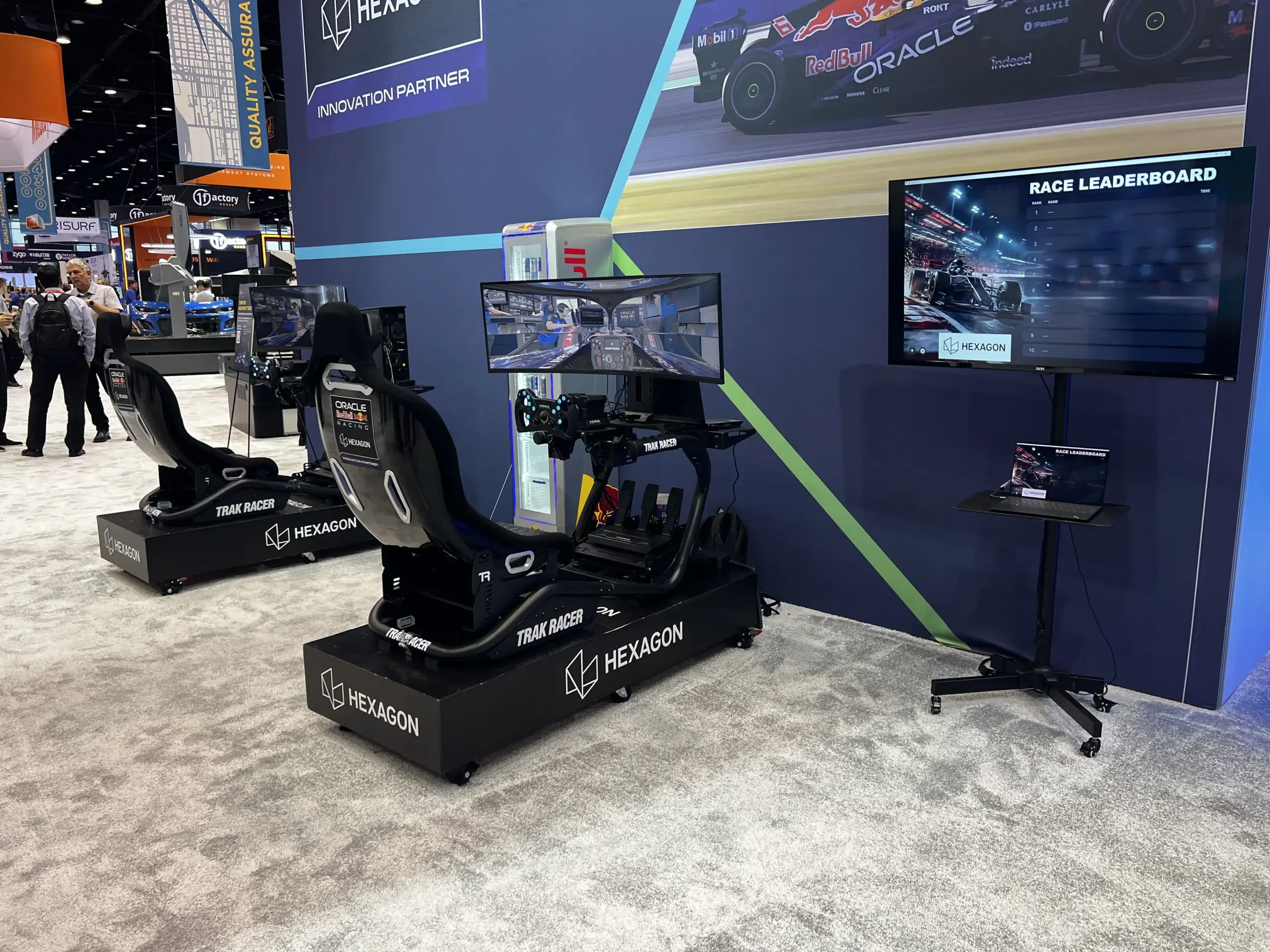
Capacity also differs a lot by game. One racing simulator serves about 10 to 15 drivers an hour, so a racing tournament for 150 people usually needs two or more. A golf simulator running a contest handles about 20 to 30 players an hour. Quick games like Catch the Stick (1 to 2 minute rounds) and the soccer reaction ring (30 to 60 second rounds) move people through faster still.
Pick a format: tournament, team scoring or open play
The same games can run three ways. Pick one, or mix them through the day.
Tournament
Players run heats, and the best results go through to a final. Racing, golf and soccer simulators work best for this because the final is easy to watch on a big screen. Tournaments suit sales teams, offsites and any group that likes a clear winner.
Team scoring
Split the group into teams before the event. Every player’s result adds to the team total across several games, so the quiet colleague who wins at BATAK matters as much as the fastest driver. This is the format that feels most like team building, because nobody can win it alone.
Open play
People walk up and play whenever they like. It suits receptions, conferences and parties where guests come and go. You can still keep a leaderboard running and hand out prizes for the top scores at the end.
How to run a team building tournament, step by step
- Set the teams in advance. Mix departments and offices, and keep teams about the same size. Share the team list a few days before so the friendly rivalry starts early.
- Choose three to five games that test different skills. Mix speed (racing), aim (golf or soccer), reflexes (BATAK, Catch the Stick) and teamwork (the Pit Stop Challenge VR). Different games give different people a chance to shine.
- Decide how points work. The easiest way: at each game, rank players by their result and give points by rank, then add up each team’s points across all the games. Put the rules on one page and share them before the event.
- Plan the rotation. Give each team a time block at each station, or let teams move freely and track scores on the leaderboard. Fixed rotations work better for groups over 100.
- Save time for a final. Bring the top players or teams back for a head-to-head final on the racing or soccer simulator in front of everyone. It is the moment people remember.
- Hand out the prizes. Trophies, a team lunch, an extra day off or gift cards all work. Announce the winners while everyone is still in the room.
When you rent the games from us, an event technician runs each station, explains the game and keeps score. You set the teams, the schedule and the prizes. We don’t host or facilitate the program, so decide in advance who will announce the results. Our tournament planning guide has more on rotations and scoring.
Best games for large group team building
Racing simulator
Head-to-head racing with a live lap-time leaderboard. Rounds take 3 to 10 minutes, so plan two or more simulators for a big group. Each one needs about 6 × 4 ft and a standard 110V outlet. See racing simulator rental.
Golf simulator
Closest to the pin, longest drive or a hole-in-one contest. Rounds take 1 to 3 minutes, and first-timers can win. It needs about 14 × 10 ft with a 10 ft ceiling. See golf simulator rental.
Soccer simulator
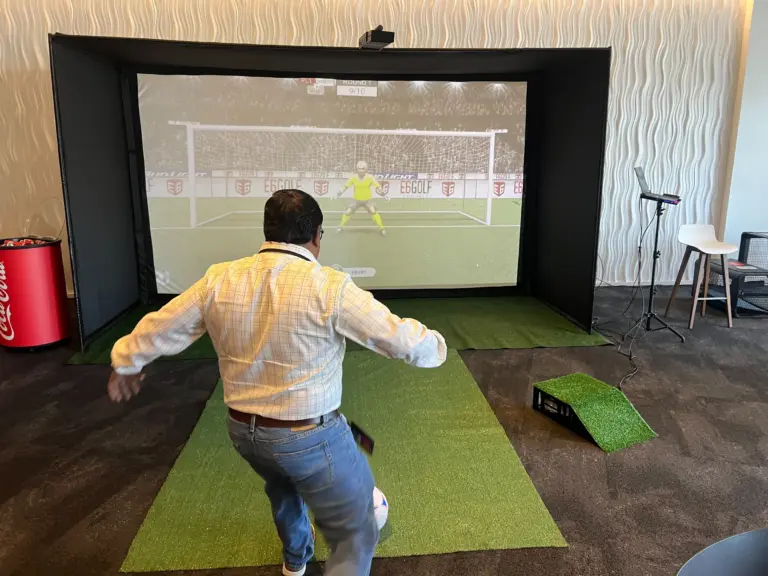
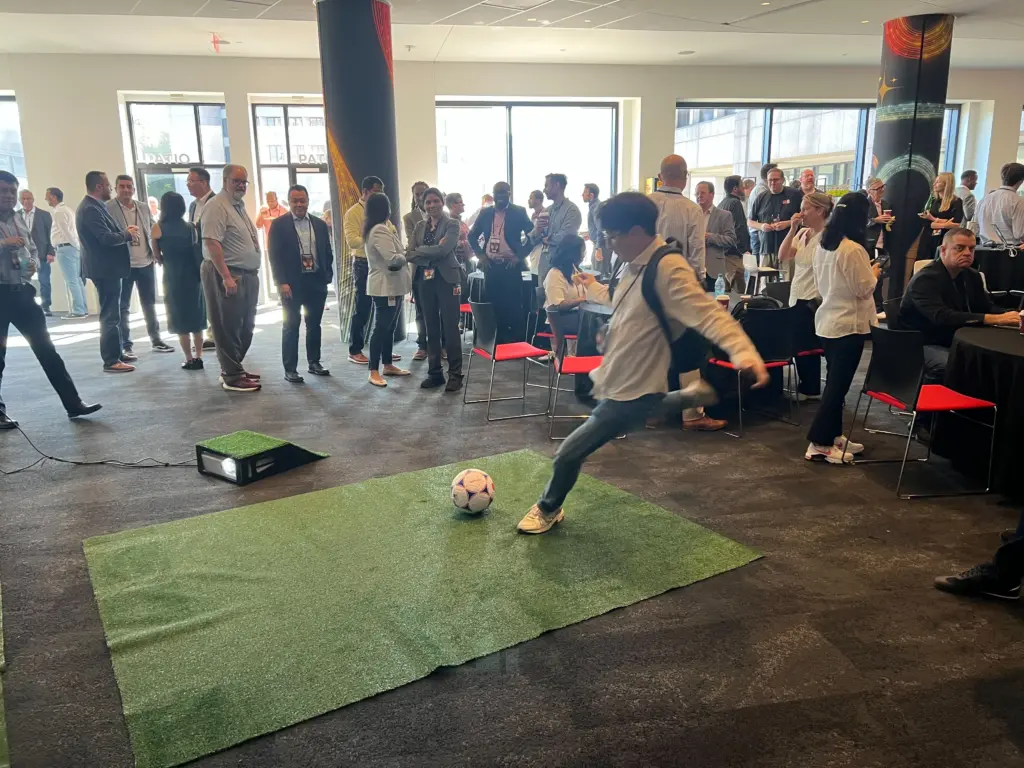
Real kicks at a projected goal, with every shot scored. A penalty shootout between departments draws a crowd fast. It needs about 14 × 12 ft with a 10 ft ceiling. See soccer simulator rental.
Catch the Stick and BATAK
Two reflex games with clear scores and short rounds. Catch the Stick needs about 6 × 6 ft and BATAK about 8 × 4 ft, so both fit in a conference room. They are great for team scoring because anyone can post a good result.
Soccer reaction ring
Players pass the ball to targets that light up around them. Rounds take 30 to 60 seconds. It needs no power, but it does need about 13 × 13 ft. See soccer reaction ring rental.
Pit Stop Challenge VR
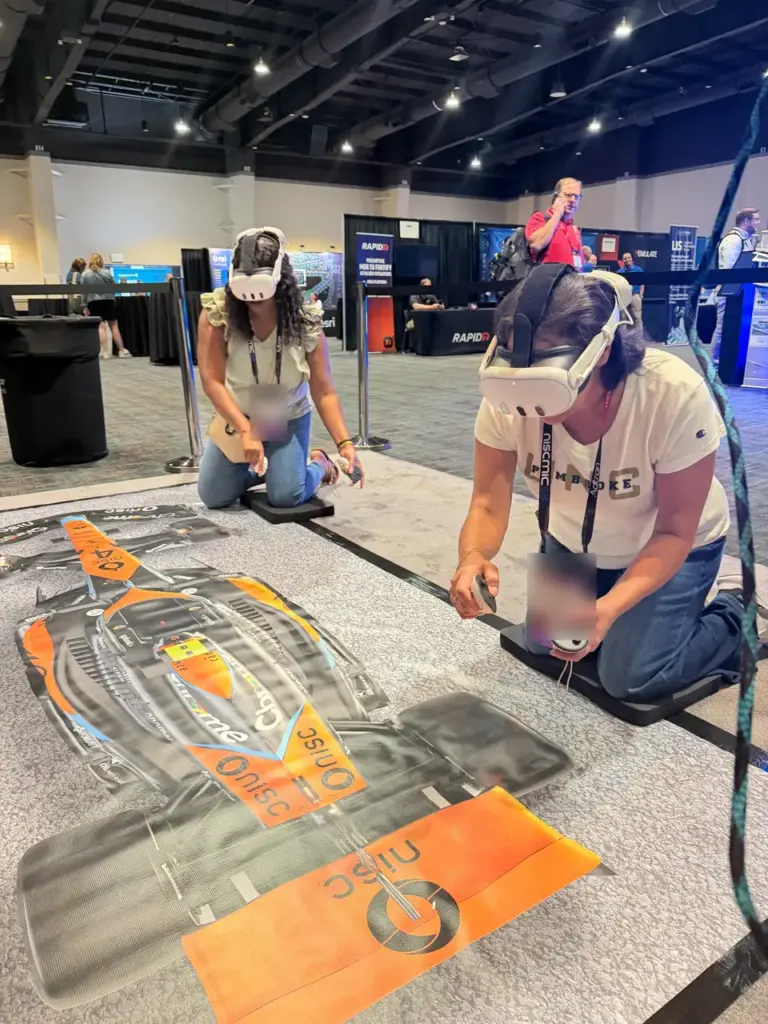
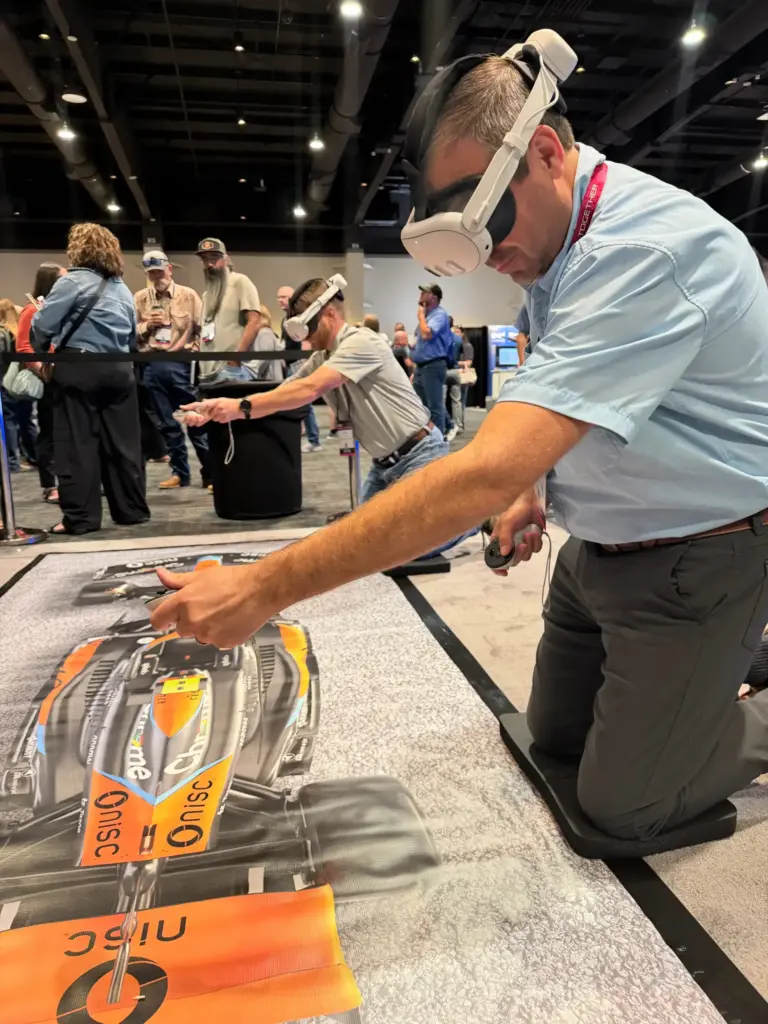
A crew of two or four puts on VR headsets and changes the tires on a race car against the clock. It is the most hands-on teamwork game we have, because nobody wins alone. Rounds take 1 to 2 minutes, and it needs about 10 × 6 ft and one dedicated 120V / 20A outlet. More in our guide to VR team building.
Real examples from company events
- Company event in Modesto, CA: about 180 guests, with two racing simulators running a fastest-lap contest on a live leaderboard and a prize for the top driver.
- Sonsray holiday party, Los Angeles: about 700 guests at The Magic Box, with 14 stations in all: 8 VR stations, 4 racing simulators, a 360 VR ride and VR laser tag.
- The Coca-Cola Company, Atlanta headquarters: employees took penalty kicks on a soccer simulator at two company events in 2025 while colleagues lined up to watch.
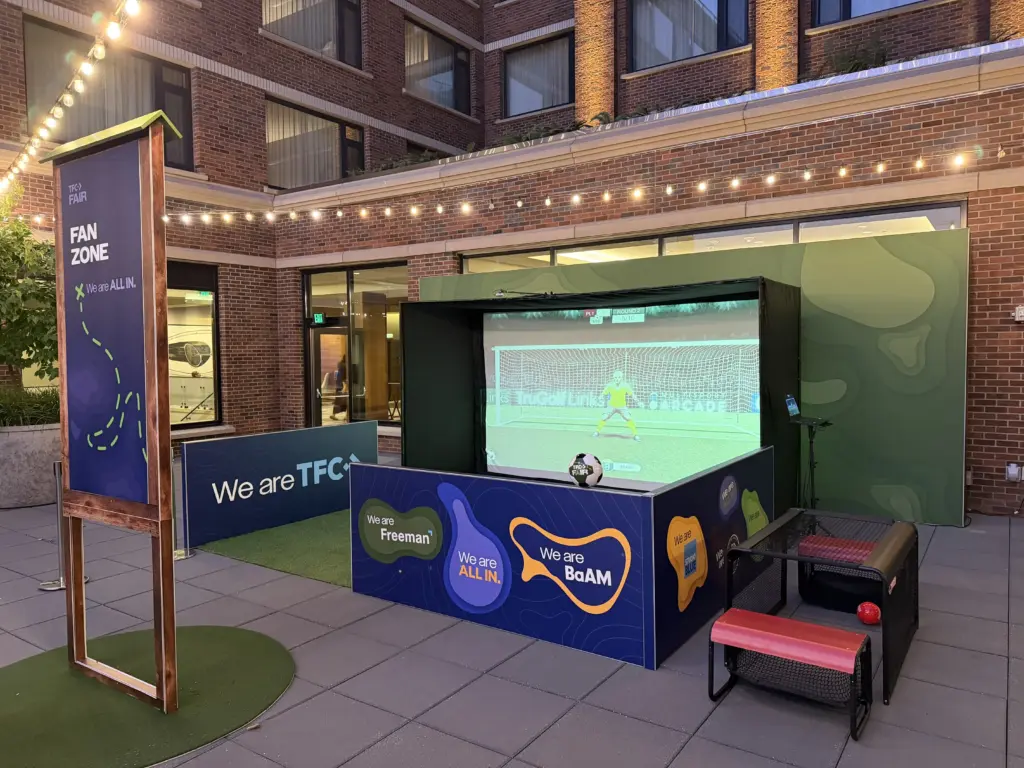
- Leadership conference near Seattle, with Sparks, a Freeman Company: a soccer fan zone with a soccer simulator and two bench soccer games on a hotel terrace.
What the venue needs
- Floor space: from about 6 × 4 ft for a racing simulator to 14 × 12 ft for the soccer simulator. Ballrooms, warehouses and large conference rooms all work.
- Power: most games run on a standard 110V outlet. The Pit Stop Challenge VR needs a dedicated 120V / 20A circuit, and the soccer reaction ring needs no power.
- Ceiling height: golf and soccer simulators need about 10 ft.
- Setup time: about 1 to 3 hours depending on the game. We set up before your group arrives and pack up after.
- Paperwork: most venues ask for a certificate of insurance, which we provide. About two weeks’ notice is usually enough to book.
Frequently asked questions
What are good team building activities for large groups?
Short, competitive games spread over several stations: racing and golf simulators, a soccer penalty shootout, reaction games like BATAK and Catch the Stick, and team games like the Pit Stop Challenge VR. One shared leaderboard ties them together.
How many game stations do we need for 200 people?
Plan on 5 to 10 stations for 150 to 500 people. For 200 people at a two- to three-hour event, five or six stations is a good start, with two racing simulators if racing is the main event.
How long should a team building tournament last?
Two to three hours is enough for each team to play three or four games and still have time for a final. For a shorter window, cut the number of games per team rather than rushing the rounds.
Do we need a facilitator?
Not for the games. Our event technicians run each station, explain the game and keep score. Someone on your side should own the schedule, the teams and the prize announcement.
Can we run a large group tournament indoors?
Yes. All of these games run indoors, and most fit in a hotel ballroom or a large conference room. See our list of indoor team building activities for room-by-room ideas.
Plan your team building event
Tell us your date, city and group size, and we will suggest a mix of games and a format. See our corporate team building activities or browse all experiences.
We bring team building games to companies across the US, with local pages for New York, Los Angeles, San Francisco, Austin, Dallas, Houston, Denver, Chicago, Boston, Las Vegas, San Antonio and Philadelphia.